Blog management services
We plan topics, brief writers and edit drafts for company blogs. We prepare and publish pages when agreed and revisit articles that need updating.

Global · English Россия · Русский
Find what is preventing search engines from accessing or indexing your pages. Get a prioritized report with example URLs and tasks for your developers.
We plan topics, brief writers and edit drafts for company blogs. We prepare and publish pages when agreed and revisit articles that need updating.
Review how shoppers find your catalogue, how search engines handle different URLs and which changes to test first.
Find how people search for your products or services. We group those searches, map them to pages and prepare SEO content briefs for the pages we agree on.
Help customers find the branch that serves them. We plan location pages, prepare local information and review available search and contact data by region.
We review your website and agree which pages and settings to work on. Then we make the initial SEO changes, check them and share the results.
Find the right catalog pages for shoppers who search by manufacturer, range or model. We review the brands you choose and deliver a search map and a plan for improving their pages.
Improve the service pages that matter most and review the visits and contact activity your site can track.
Review access, indexing and how redirects or URL variants behave.
Check title tags, descriptions and patterns across shared page templates.
Receive example URLs, supporting evidence and tasks your developers can check after a fix.
Agree on page types, affected areas and available data.
Review representative URLs and record findings with supporting evidence.
Discuss priorities and the next steps for your development team.
A technical SEO audit helps your team decide what to fix when search engines have trouble accessing or indexing pages. We review the agreed areas in a one-time audit and show what we found on specific URLs.
You receive a report with priorities and tasks your developers can use to plan the work. Each finding includes enough context for your team to see what needs attention and why.
Consider an audit when one of these changes leaves you with a technical question.
A standalone audit suits teams that want to make those decisions first and schedule the fixes themselves.
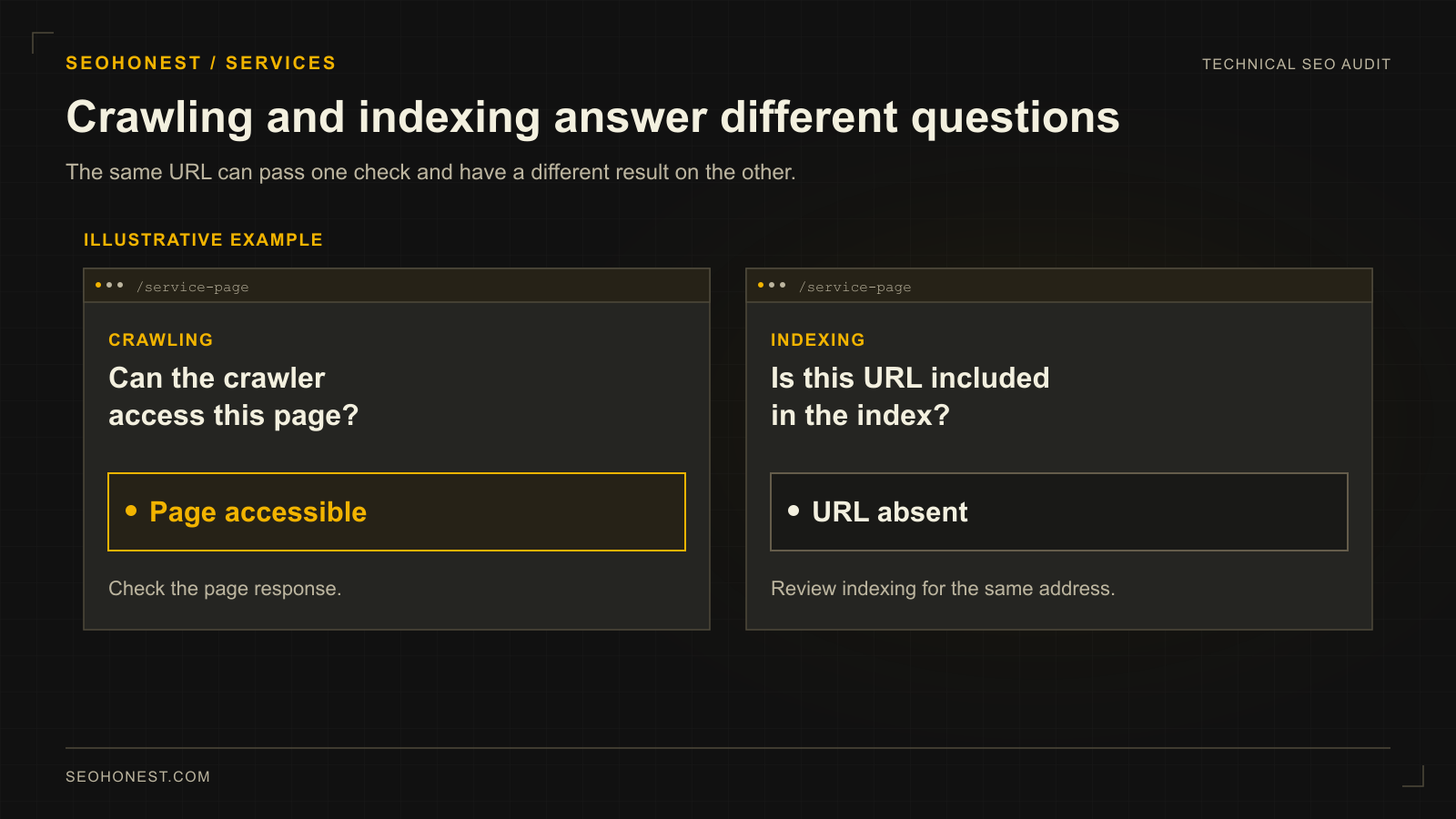
We look at crawling and indexing separately. A crawlability check asks whether a search engine can access a page. An indexing check asks whether the search engine has included it in its index. A page can be accessible to a crawler and still be absent from the index.
The checks depend on how your site is built and which pages matter to you. We look at redirects to see where they send visitors and crawlers. We review URL parameters and duplicate addresses to see whether multiple URLs lead to essentially the same page. We also check title tags, meta descriptions, and the templates that generate them. A problem in a shared template can appear across pages built from it, so we look for patterns as well as individual examples.
For an online store, the review can include category and product pages, along with URLs created by filters or sorting. For a regional site, we may look at how different versions of a page are organized or how content is divided across subdomains. The audit focuses on the page types and URL patterns we agree to review with you.
The audit report gives your developers example URLs and explains what we observed on them. We give each issue a priority so your team can decide which work to schedule first. A confirmed finding comes with evidence. If a possible cause still needs investigation, we record it as a hypothesis and specify what evidence would help confirm it.
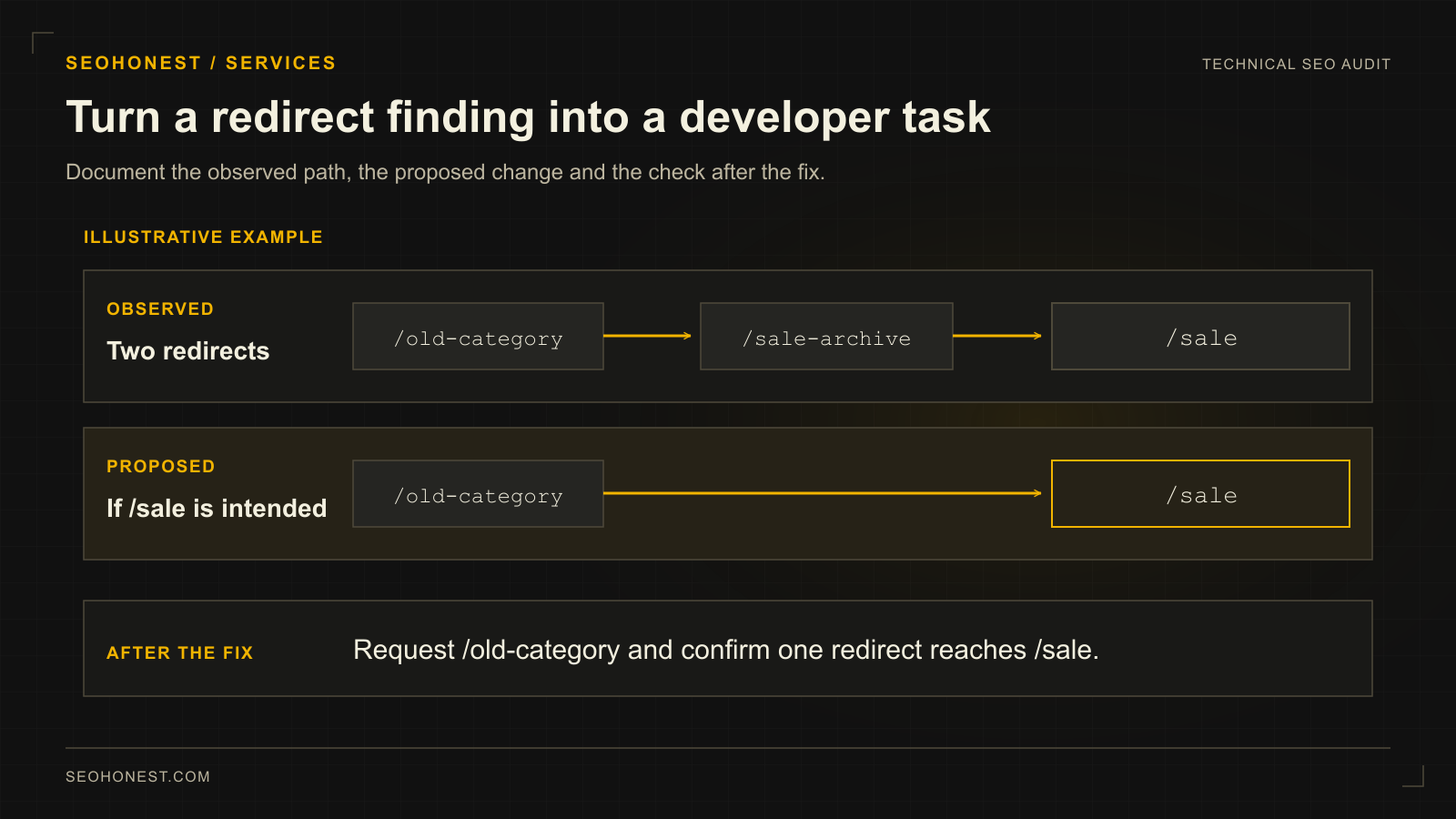
The following hypothetical example shows how an observation becomes a task your team can check after a fix.
| Example URL and observation | Priority and developer task | Check after the fix |
|---|---|---|
/old-category redirects through /sale-archive before reaching /sale. |
Medium priority in this example. If /sale is the intended destination, point /old-category directly to it. |
Request /old-category again and confirm that one redirect reaches /sale. |
You can use the report to brief your own developers. We scope implementation and checks after the fixes separately. If you want to plan and review changes over successive rounds of work, you can discuss ongoing SEO services with us.
In the NDO technical SEO audit, we examined how the site handled URL variants across languages. The review covered indexing, duplicate URLs, title tags and meta descriptions, and redirects.
NDO received a checklist, URL exports, and a plan for the technical work. The package contained 14 sheets for this project. The team could use the exports to find the pages discussed in the audit and refer to the plan when assigning the work.
We prepare the quote based on the size of your site, the page types involved, and the checks you need. The data available for review also helps us define the scope. For example, access to search and analytics records can give us more information about the pages where you have noticed a change.
Send us your website URL, the issue you want to investigate, and any major changes you have made recently. If you can, include an example URL from the affected part of the site. A request about one catalog section may call for a different set of checks than a review of several regional versions.
Send the site address, the issue you want to investigate and any major recent changes. Example URLs help us define the scope.
We scope implementation and the checks after a fix separately.
Share your site and what you want to improve. We can suggest a starting point and explain what the work would involve.